Performance Turnaround
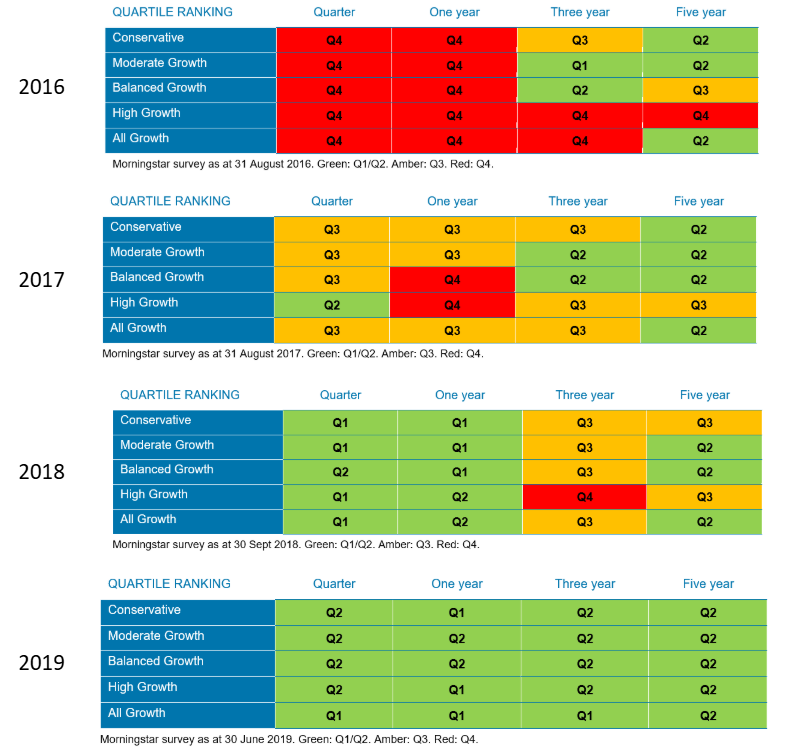
Improved performance of the US$12bn AMP Diversified Series (defined contribution retirement funds), a range of traditional portfolios targeting top-half rankings (Q1 or Q2) in the Morningstar Superannuation Survey. Three changes drove the turnaround:
- Systematized the active overlay process. I shifted the sizing framework from notional weight to volatility, scaled positions by conviction, and built an options-based tail-risk hedging framework across the range. The previous heuristics produced misleading sizing. For example: the largest active position when I took over was an 8% underweight to bonds (and overweight to cash) held with low conviction on the view that “bonds aren’t that volatile, so it’s a small position.” On a volatility/tracking error basis it was in fact the largest active position in the portfolio, with little conviction behind it beyond “bonds seem a little expensive.” Reducing it proved correct, as rates fell for another four years and bonds continued to outperform cash.
- Removed underperforming managers. One large equity allocation had lagged its benchmark by 8% (market up 9%, fund up 2%). The team had originally been three groups; two left for better-paying roles elsewhere, and the remaining team admitted they had “too much money to manage” and were reluctant to trade the book. Compounding the issue, the multi-asset overlay was short futures on that asset class to reduce beta, effectively levering us into the underperformance. Cutting the allocation and the futures was straightforward as an investor but harder organisationally, since the team sat within the same business.
- Aligned the strategic asset allocation across all three objectives. The portfolios were measured against an SAA benchmark, a peer group, and an absolute return target. Through the annual SAA review, I aligned the benchmark allocation with peers and the absolute return objective so that a single active tilt would work for all three. Previously, a 1% overweight to US equity relative to SAA could still be an underweight versus peers, meaning a correct call would beat the benchmark but lag the peer group. The alignment was contrary to prevailing team thinking at the time.
The portfolios moved from consistently ranking in the bottom quartile (Q4) to Q1 and Q2.